
Mitosis vs. Meiosis
Views: 0 — Posted Aug 13, 2026
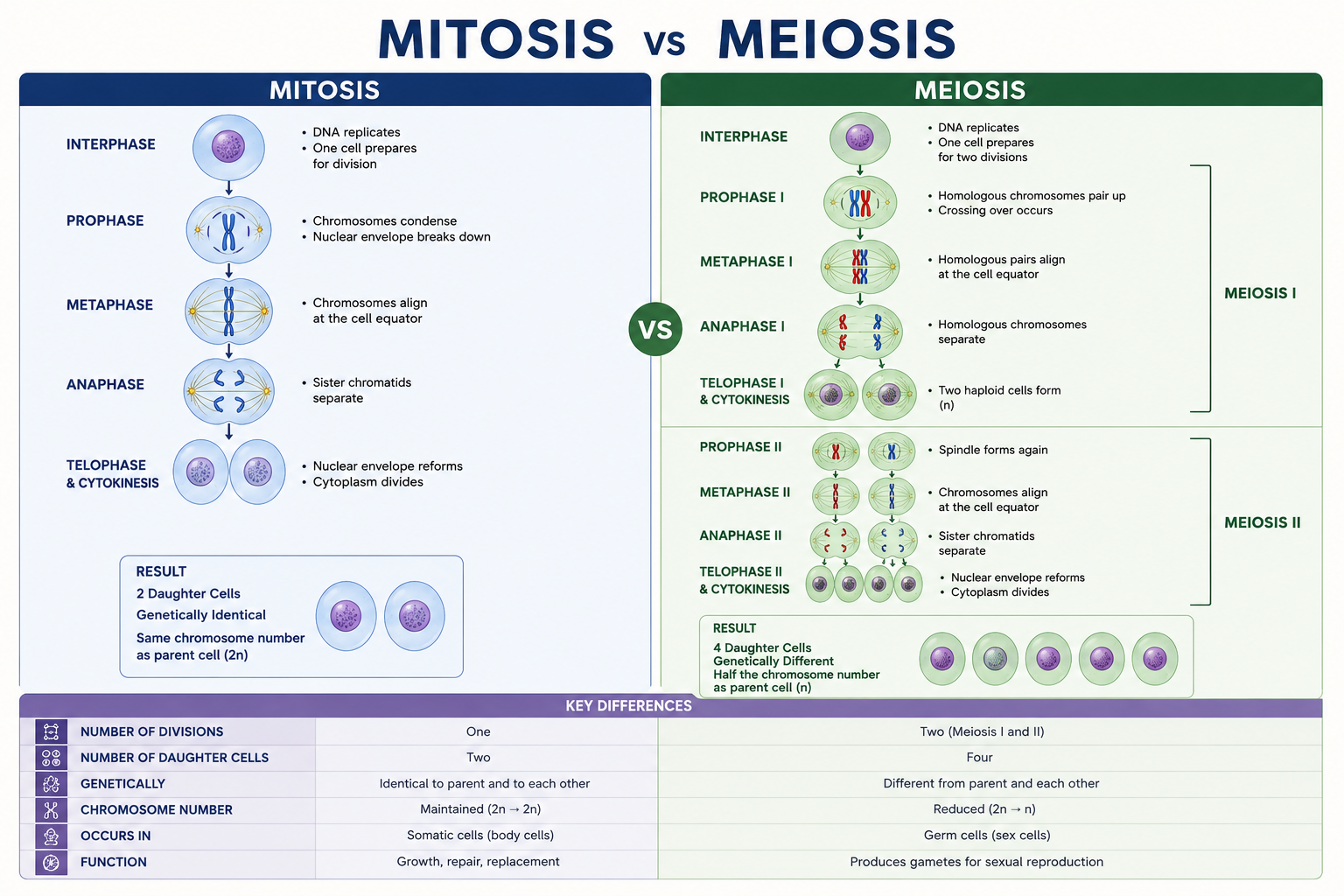
Cell division is one of the most important processes in biology because it allows organisms to grow, develop, repair damaged tissues, and reproduce. Two major types of nuclear division are mitosis and meiosis. Although both processes involve the duplication and distribution of genetic material, they have different purposes and produce different results.
Mitosis is mainly associated with the growth and maintenance of an organism. It produces new cells that generally contain the same number of chromosomes as the original cell. Meiosis, in contrast, is associated with sexual reproduction and produces cells containing half the chromosome number of the original cell. In humans, for example, most body cells contain 46 chromosomes, whereas mature reproductive cells contain 23 chromosomes.
Both processes begin after DNA has been replicated, but their division patterns are different. Mitosis involves one nuclear division and normally produces two daughter cells. Meiosis involves two successive nuclear divisions and normally produces four haploid cells. Meiosis also includes mechanisms such as crossing over and independent assortment, which contribute to genetic variation. These fundamental differences make mitosis and meiosis suitable for different biological functions.
Mitosis is mainly associated with the growth and maintenance of an organism. It produces new cells that generally contain the same number of chromosomes as the original cell. Meiosis, in contrast, is associated with sexual reproduction and produces cells containing half the chromosome number of the original cell. In humans, for example, most body cells contain 46 chromosomes, whereas mature reproductive cells contain 23 chromosomes.
Both processes begin after DNA has been replicated, but their division patterns are different. Mitosis involves one nuclear division and normally produces two daughter cells. Meiosis involves two successive nuclear divisions and normally produces four haploid cells. Meiosis also includes mechanisms such as crossing over and independent assortment, which contribute to genetic variation. These fundamental differences make mitosis and meiosis suitable for different biological functions.
What Is Mitosis?
Mitosis is a type of cell division in which one parent cell divides its duplicated chromosomes so that the resulting daughter cells receive essentially the same genetic information. It is particularly important in multicellular organisms for growth, development, tissue replacement, and repair.
Before mitosis begins, the cell passes through interphase, during which DNA is copied. The duplicated chromosomes then become organized and separated during the stages of mitosis. The major stages are prophase, metaphase, anaphase, and telophase, followed by cytokinesis, in which the cytoplasm divides.
During metaphase, duplicated chromosomes align individually near the middle of the cell. During anaphase, sister chromatids separate and move toward opposite sides of the cell. Following telophase and cytokinesis, two daughter cells are normally formed.
In humans, mitosis generally occurs in somatic, or body, cells. Because the chromosome number is maintained, a diploid human cell normally produces two diploid daughter cells. This makes mitosis well suited to processes where the body needs genetically consistent replacement cells.
Before mitosis begins, the cell passes through interphase, during which DNA is copied. The duplicated chromosomes then become organized and separated during the stages of mitosis. The major stages are prophase, metaphase, anaphase, and telophase, followed by cytokinesis, in which the cytoplasm divides.
During metaphase, duplicated chromosomes align individually near the middle of the cell. During anaphase, sister chromatids separate and move toward opposite sides of the cell. Following telophase and cytokinesis, two daughter cells are normally formed.
In humans, mitosis generally occurs in somatic, or body, cells. Because the chromosome number is maintained, a diploid human cell normally produces two diploid daughter cells. This makes mitosis well suited to processes where the body needs genetically consistent replacement cells.
What Is Meiosis?
Meiosis is a specialized form of cell division involved in sexual reproduction. Its primary purpose is to reduce the chromosome number by half and generate genetically varied reproductive cells.
Unlike mitosis, meiosis contains two rounds of nuclear division: meiosis I and meiosis II. However, DNA is replicated only once before these two divisions. During meiosis I, homologous chromosomes pair and are separated. During meiosis II, sister chromatids are separated.
One of the most important features of meiosis is crossing over, which occurs during prophase I. Homologous chromosomes exchange sections of DNA, producing new combinations of genetic material. The random orientation of homologous chromosome pairs during metaphase I also contributes to genetic variation through independent assortment.
At the end of meiosis, a diploid starting cell generally gives rise to four haploid cells. In humans, these cells contain 23 chromosomes rather than the 46 chromosomes found in typical diploid body cells.
Unlike mitosis, meiosis contains two rounds of nuclear division: meiosis I and meiosis II. However, DNA is replicated only once before these two divisions. During meiosis I, homologous chromosomes pair and are separated. During meiosis II, sister chromatids are separated.
One of the most important features of meiosis is crossing over, which occurs during prophase I. Homologous chromosomes exchange sections of DNA, producing new combinations of genetic material. The random orientation of homologous chromosome pairs during metaphase I also contributes to genetic variation through independent assortment.
At the end of meiosis, a diploid starting cell generally gives rise to four haploid cells. In humans, these cells contain 23 chromosomes rather than the 46 chromosomes found in typical diploid body cells.
Basic Difference: Mitosis vs. Meiosis
The most fundamental difference between mitosis and meiosis is their biological purpose.
Mitosis supports growth, development, cell replacement, and tissue repair. When an organism needs additional body cells, mitosis allows existing cells to produce new cells while maintaining the chromosome number.
Meiosis is designed for sexual reproduction. It produces haploid reproductive cells so that fertilization can restore the diploid chromosome number. Without chromosome reduction during meiosis, chromosome numbers would continually increase with each generation following fertilization.
Mitosis supports growth, development, cell replacement, and tissue repair. When an organism needs additional body cells, mitosis allows existing cells to produce new cells while maintaining the chromosome number.
Meiosis is designed for sexual reproduction. It produces haploid reproductive cells so that fertilization can restore the diploid chromosome number. Without chromosome reduction during meiosis, chromosome numbers would continually increase with each generation following fertilization.
Difference in Number of Divisions
Mitosis includes one major nuclear division. Once chromosome duplication has taken place, the chromosomes are separated during a single sequence of division events.
Meiosis consists of two nuclear divisions. These are called meiosis I and meiosis II.
Meiosis I separates homologous chromosomes, while meiosis II separates sister chromatids. Therefore, meiosis requires two division stages to achieve its characteristic reduction in chromosome number and production of haploid cells.
Meiosis consists of two nuclear divisions. These are called meiosis I and meiosis II.
Meiosis I separates homologous chromosomes, while meiosis II separates sister chromatids. Therefore, meiosis requires two division stages to achieve its characteristic reduction in chromosome number and production of haploid cells.
Difference in the Number of Daughter Cells
Mitosis usually results in two daughter cells from one parent cell.
Meiosis normally produces four daughter cells from one starting cell.
This difference is directly related to the number of divisions. A single mitotic division produces two cells, whereas the two successive divisions of meiosis can result in four cells.
Meiosis normally produces four daughter cells from one starting cell.
This difference is directly related to the number of divisions. A single mitotic division produces two cells, whereas the two successive divisions of meiosis can result in four cells.
Effect on Chromosome Number
Mitosis generally preserves the chromosome number of the parent cell. For example, a diploid human cell containing 46 chromosomes normally produces daughter cells containing 46 chromosomes.
Meiosis reduces the chromosome number by half. In humans, a diploid cell with 46 chromosomes undergoes meiosis to produce haploid cells containing 23 chromosomes.
This reduction is essential for sexual reproduction because the fusion of a sperm cell and an egg cell restores the diploid number in the resulting zygote.
Meiosis reduces the chromosome number by half. In humans, a diploid cell with 46 chromosomes undergoes meiosis to produce haploid cells containing 23 chromosomes.
This reduction is essential for sexual reproduction because the fusion of a sperm cell and an egg cell restores the diploid number in the resulting zygote.
Genetic Similarity of the Products
Another important difference concerns the genetic characteristics of the daughter cells.
The products of mitosis are generally genetically very similar to the parent cell and to one another, assuming no mutation or other genetic change occurs. This consistency is important for tissue growth and repair.
The products of meiosis are genetically different from one another. Crossing over and independent assortment create different combinations of chromosomes and genetic information. Consequently, meiosis contributes significantly to genetic diversity within sexually reproducing populations.
The products of mitosis are generally genetically very similar to the parent cell and to one another, assuming no mutation or other genetic change occurs. This consistency is important for tissue growth and repair.
The products of meiosis are genetically different from one another. Crossing over and independent assortment create different combinations of chromosomes and genetic information. Consequently, meiosis contributes significantly to genetic diversity within sexually reproducing populations.
Pairing of Homologous Chromosomes
Homologous chromosomes do not normally pair with one another during mitosis.
Meiosis is different because homologous chromosomes pair during prophase I. The maternal and paternal versions of corresponding chromosomes come together, forming paired structures that allow genetic recombination to occur.
This pairing is one of the defining characteristics of meiosis I and does not occur in ordinary mitosis.
Meiosis is different because homologous chromosomes pair during prophase I. The maternal and paternal versions of corresponding chromosomes come together, forming paired structures that allow genetic recombination to occur.
This pairing is one of the defining characteristics of meiosis I and does not occur in ordinary mitosis.
Crossing Over and Genetic Recombination
Crossing over is generally absent from normal mitosis but is a major feature of meiosis.
During prophase I of meiosis, homologous chromosomes associate and can exchange corresponding segments of DNA. The exchange creates recombinant chromosomes containing new combinations of genetic variants.
This process helps explain why siblings from the same parents can have different combinations of inherited characteristics. Genetic diversity generated during meiosis is also important for populations because it provides variation on which evolutionary processes can act.
During prophase I of meiosis, homologous chromosomes associate and can exchange corresponding segments of DNA. The exchange creates recombinant chromosomes containing new combinations of genetic variants.
This process helps explain why siblings from the same parents can have different combinations of inherited characteristics. Genetic diversity generated during meiosis is also important for populations because it provides variation on which evolutionary processes can act.
Chromosome Arrangement During Division
In mitosis, individual duplicated chromosomes line up at the cell's equatorial region during metaphase.
In meiosis I, homologous chromosomes are arranged as pairs at the equatorial region. Their orientation is random, which contributes to independent assortment.
During meiosis II, the chromosomes line up more similarly to those in mitosis because sister chromatids are prepared for separation. Thus, meiosis II resembles mitosis more closely than meiosis I does.
In meiosis I, homologous chromosomes are arranged as pairs at the equatorial region. Their orientation is random, which contributes to independent assortment.
During meiosis II, the chromosomes line up more similarly to those in mitosis because sister chromatids are prepared for separation. Thus, meiosis II resembles mitosis more closely than meiosis I does.
Separation of Chromosomal Material
Mitosis separates sister chromatids during anaphase. Each daughter cell receives one copy of each chromosome.
Meiosis divides this task between two stages. During anaphase I, homologous chromosomes move to opposite poles while sister chromatids remain together. During anaphase II, sister chromatids finally separate.
This two-step separation is responsible for the reduction of chromosome sets during meiosis I followed by chromatid separation during meiosis II.
Meiosis divides this task between two stages. During anaphase I, homologous chromosomes move to opposite poles while sister chromatids remain together. During anaphase II, sister chromatids finally separate.
This two-step separation is responsible for the reduction of chromosome sets during meiosis I followed by chromatid separation during meiosis II.
Type of Cells Involved
Mitosis is commonly associated with somatic cells, meaning cells that form the body tissues of an organism.
Meiosis occurs in specialized cells associated with the reproductive system and ultimately gives rise to gametes in animals. In humans, meiosis is responsible for producing sperm and eggs.
Therefore, mitosis is mainly connected with maintaining the organism's body, while meiosis is connected with producing cells needed for sexual reproduction.
Meiosis occurs in specialized cells associated with the reproductive system and ultimately gives rise to gametes in animals. In humans, meiosis is responsible for producing sperm and eggs.
Therefore, mitosis is mainly connected with maintaining the organism's body, while meiosis is connected with producing cells needed for sexual reproduction.
Importance in Growth and Reproduction
Mitosis and meiosis have different but complementary biological roles.
Mitosis enables a multicellular organism to increase its number of cells as it grows. It also allows damaged or old cells to be replaced.
Meiosis, on the other hand, supports sexual reproduction by producing haploid reproductive cells. When two haploid gametes unite during fertilization, their chromosome sets combine to form a diploid cell.
Thus, mitosis helps maintain the individual organism, while meiosis helps maintain the reproductive cycle of sexually reproducing organisms.
Mitosis enables a multicellular organism to increase its number of cells as it grows. It also allows damaged or old cells to be replaced.
Meiosis, on the other hand, supports sexual reproduction by producing haploid reproductive cells. When two haploid gametes unite during fertilization, their chromosome sets combine to form a diploid cell.
Thus, mitosis helps maintain the individual organism, while meiosis helps maintain the reproductive cycle of sexually reproducing organisms.
Difference in Genetic Variation
Mitosis generally emphasizes genetic stability. Its products maintain essentially the same genetic information as the parent cell.
Meiosis emphasizes genetic variation. Crossing over, independent assortment, and the random combination of parental chromosomes generate genetically different reproductive cells.
This distinction is particularly important because genetic variation provides differences among offspring, while mitosis ensures that newly produced body cells can perform their required functions with consistent genetic information.
Meiosis emphasizes genetic variation. Crossing over, independent assortment, and the random combination of parental chromosomes generate genetically different reproductive cells.
This distinction is particularly important because genetic variation provides differences among offspring, while mitosis ensures that newly produced body cells can perform their required functions with consistent genetic information.
Mitosis vs. Meiosis: Comparison Table
Feature Mitosis Meiosis
Main function Growth, repair, development, and cell replacement Sexual reproduction and production of haploid cells
Number of nuclear divisions One Two
Number of resulting cells Usually two Usually four
Chromosome number Usually maintained Reduced by half
Genetic similarity Daughter cells are generally very similar Daughter cells are genetically different
Homologous chromosome pairing Absent Occurs during prophase I
Crossing over Normally absent Occurs during prophase I
Independent assortment Not a defining feature Important source of genetic variation
Main cell association Somatic/body cells Germ-line/reproductive cells
Separation in first division Sister chromatids separate Homologous chromosomes separate
DNA replication Once before division Once before meiosis I
Role in humans Produces most new body cells Produces sperm or eggs
Final chromosome condition Same ploidy level as starting cell Haploid
Genetic variation Generally limited Significant
Number of division stages One complete division Meiosis I and meiosis II
Feature Mitosis Meiosis
Main function Growth, repair, development, and cell replacement Sexual reproduction and production of haploid cells
Number of nuclear divisions One Two
Number of resulting cells Usually two Usually four
Chromosome number Usually maintained Reduced by half
Genetic similarity Daughter cells are generally very similar Daughter cells are genetically different
Homologous chromosome pairing Absent Occurs during prophase I
Crossing over Normally absent Occurs during prophase I
Independent assortment Not a defining feature Important source of genetic variation
Main cell association Somatic/body cells Germ-line/reproductive cells
Separation in first division Sister chromatids separate Homologous chromosomes separate
DNA replication Once before division Once before meiosis I
Role in humans Produces most new body cells Produces sperm or eggs
Final chromosome condition Same ploidy level as starting cell Haploid
Genetic variation Generally limited Significant
Number of division stages One complete division Meiosis I and meiosis II
FAQ
1. What is the simplest difference between mitosis and meiosis?
The simplest distinction is that mitosis produces two genetically similar cells and generally maintains the chromosome number, whereas meiosis produces four genetically different haploid cells and reduces the chromosome number by half.
2. Which process produces more daughter cells?
Meiosis generally produces four daughter cells, while mitosis usually produces two. The difference occurs because meiosis involves two successive nuclear divisions, whereas mitosis involves one.
3. Does DNA replicate twice during meiosis?
No. DNA is replicated once before meiosis begins, followed by two nuclear divisions. There is no second round of DNA replication between meiosis I and meiosis II.
4. Why does meiosis reduce the chromosome number?
Meiosis reduces chromosome number so that reproductive cells contain one chromosome set. When two haploid gametes combine during fertilization, the diploid chromosome number is restored. This prevents chromosome numbers from doubling in every generation.
5. Where does crossing over occur?
Crossing over occurs during prophase I of meiosis. Homologous chromosomes pair and exchange corresponding sections of DNA, producing recombinant chromosomes and contributing to genetic variation.
6. Which process is responsible for growth and tissue repair?
Mitosis is the principal cell-division process associated with growth, development, and replacement of body cells. It allows new cells to be produced while generally maintaining the same chromosome number.
7. Which process produces sperm and eggs in humans?
Meiosis produces the cells that develop into the reproductive cells of humans. Sperm are produced through meiosis in the male reproductive system, while egg development involves meiosis in the female reproductive system.
8. Are the daughter cells produced by meiosis identical?
No. The products of meiosis are generally genetically different. Crossing over and independent assortment create different combinations of genetic material among the resulting haploid cells.
9. Do homologous chromosomes pair during mitosis?
No. Homologous chromosomes do not normally pair with one another during mitosis. Pairing of homologous chromosomes is a characteristic feature of meiosis I.
10. Which division is called the reduction division?
Meiosis I is called the reduction division because it reduces the chromosome-set level from diploid to haploid. Homologous chromosomes separate during this division. Meiosis II separates sister chromatids but does not produce another reduction in ploidy.
11. Is meiosis II similar to mitosis?
Yes, in several important respects. During both meiosis II and mitosis, sister chromatids separate. However, the cells entering meiosis II are already haploid, and the chromosomes may contain recombinant DNA produced during meiosis I.
12. Why is meiosis important for genetic diversity?
Meiosis creates genetic variation through processes including crossing over and independent assortment. These mechanisms generate reproductive cells with different combinations of genetic material, increasing variation among offspring in sexually reproducing organisms.
The simplest distinction is that mitosis produces two genetically similar cells and generally maintains the chromosome number, whereas meiosis produces four genetically different haploid cells and reduces the chromosome number by half.
2. Which process produces more daughter cells?
Meiosis generally produces four daughter cells, while mitosis usually produces two. The difference occurs because meiosis involves two successive nuclear divisions, whereas mitosis involves one.
3. Does DNA replicate twice during meiosis?
No. DNA is replicated once before meiosis begins, followed by two nuclear divisions. There is no second round of DNA replication between meiosis I and meiosis II.
4. Why does meiosis reduce the chromosome number?
Meiosis reduces chromosome number so that reproductive cells contain one chromosome set. When two haploid gametes combine during fertilization, the diploid chromosome number is restored. This prevents chromosome numbers from doubling in every generation.
5. Where does crossing over occur?
Crossing over occurs during prophase I of meiosis. Homologous chromosomes pair and exchange corresponding sections of DNA, producing recombinant chromosomes and contributing to genetic variation.
6. Which process is responsible for growth and tissue repair?
Mitosis is the principal cell-division process associated with growth, development, and replacement of body cells. It allows new cells to be produced while generally maintaining the same chromosome number.
7. Which process produces sperm and eggs in humans?
Meiosis produces the cells that develop into the reproductive cells of humans. Sperm are produced through meiosis in the male reproductive system, while egg development involves meiosis in the female reproductive system.
8. Are the daughter cells produced by meiosis identical?
No. The products of meiosis are generally genetically different. Crossing over and independent assortment create different combinations of genetic material among the resulting haploid cells.
9. Do homologous chromosomes pair during mitosis?
No. Homologous chromosomes do not normally pair with one another during mitosis. Pairing of homologous chromosomes is a characteristic feature of meiosis I.
10. Which division is called the reduction division?
Meiosis I is called the reduction division because it reduces the chromosome-set level from diploid to haploid. Homologous chromosomes separate during this division. Meiosis II separates sister chromatids but does not produce another reduction in ploidy.
11. Is meiosis II similar to mitosis?
Yes, in several important respects. During both meiosis II and mitosis, sister chromatids separate. However, the cells entering meiosis II are already haploid, and the chromosomes may contain recombinant DNA produced during meiosis I.
12. Why is meiosis important for genetic diversity?
Meiosis creates genetic variation through processes including crossing over and independent assortment. These mechanisms generate reproductive cells with different combinations of genetic material, increasing variation among offspring in sexually reproducing organisms.
Conclusion
Mitosis and meiosis are both essential forms of cell division, but they perform distinctly different biological functions. Mitosis is primarily a maintenance and growth process, producing two daughter cells that generally retain the chromosome number and genetic characteristics of the parent cell. It is therefore important for development, tissue growth, repair, and replacement.
Meiosis is primarily a reproductive process, involving two successive divisions after a single round of DNA replication. It produces four haploid cells and reduces the chromosome number by half. More importantly, meiosis introduces genetic variation through crossing over and independent assortment.
The easiest way to remember the difference is: mitosis maintains; meiosis varies and reduces. Mitosis maintains chromosome number and genetic stability, while meiosis reduces chromosome number and creates genetic diversity. Together, these two processes allow organisms to grow and maintain their bodies while also reproducing and passing genetic information from one generation to the next.